

Calisthenics, also known as bodyweight training, is a form of exercise that utilizes an individual’s body weight for resistance. This versatile and effective method helps build strength, flexibility, and endurance. Before initiating a calisthenics routine, it is essential to establish a solid foundation by assessing current fitness levels, setting specific goals, and creating a structured workout plan.
Assessing current fitness levels is crucial for determining an appropriate starting point in a calisthenics routine. This assessment can be conducted through basic exercises such as push-ups, squats, and planks, which provide insight into an individual’s strength and endurance capabilities. Once a clear understanding of current abilities is established, specific goals can be set for calisthenics training.
These goals may include mastering particular exercises like pull-ups or improving overall strength and flexibility. With clearly defined goals, the next step is to develop a structured workout plan. This plan should incorporate a variety of exercises targeting different muscle groups and include a schedule specifying training frequency and duration.
By establishing a solid foundation through fitness assessment, goal-setting, and structured planning, individuals can ensure their calisthenics routine is both effective and sustainable.
Key Takeaways
- Setting the Foundation: A solid calisthenics routine should include a variety of bodyweight exercises targeting different muscle groups.
- Building Strength: Progressing from zero to one pull-up requires consistent practice, proper form, and gradually increasing the number of repetitions.
- Mastering the Basics: Developing proper form and technique is essential for preventing injuries and maximizing the effectiveness of calisthenics exercises.
- Overcoming Plateaus: Strategies for breaking through barriers include adjusting the intensity, incorporating new exercises, and focusing on weak areas.
- Advanced Techniques: Incorporating variations and progressions such as muscle-ups, handstand push-ups, and one-arm push-ups can take your calisthenics routine to the next level.
- Fine-Tuning Nutrition: Fueling your body with a balanced diet rich in protein, carbohydrates, and healthy fats is crucial for optimal performance and recovery.
- Celebrating Success: Achieving the muscle-up milestone is a significant accomplishment that showcases your strength, dedication, and progress in calisthenics.
Building Strength: Progressing from Zero to One Pull-Up
The pull-up is a fundamental exercise in calisthenics that requires upper body strength and control. For many beginners, the thought of doing a pull-up can seem daunting, but with the right progression and dedication, it is achievable. Starting from zero pull-ups, the first step is to build the necessary strength through exercises such as inverted rows, negative pull-ups, and assisted pull-ups.
Inverted rows are performed by lying underneath a bar or table and pulling your body up towards it. This exercise helps to strengthen the muscles used in pull-ups while providing support from the ground. Negative pull-ups involve starting at the top of the pull-up position and slowly lowering yourself down.
This eccentric movement helps to build strength in the muscles used for pull-ups. Assisted pull-ups can be done using resistance bands or a partner to provide support as you work on pulling yourself up. Once you have built enough strength through these progression exercises, it’s time to attempt your first pull-up.
Start by gripping the bar with an overhand grip slightly wider than shoulder-width apart. Engage your core and pull yourself up towards the bar, focusing on using your back muscles to initiate the movement. If you are unable to complete a full pull-up at first, continue practicing the progression exercises while gradually increasing the number of attempts at the pull-up.
With consistent effort and dedication, you will eventually be able to perform your first pull-up. Progressing from zero to one pull-up may seem challenging, but with the right progression exercises and dedication, it is an achievable goal. The pull-up is a fundamental exercise in calisthenics that requires upper body strength and control.
For many beginners, the thought of doing a pull-up can seem daunting, but with the right progression and dedication, it is achievable. Starting from zero pull-ups, the first step is to build the necessary strength through exercises such as inverted rows, negative pull-ups, and assisted pull-ups. Inverted rows are performed by lying underneath a bar or table and pulling your body up towards it.
This exercise helps to strengthen the muscles used in pull-ups while providing support from the ground. Negative pull-ups involve starting at the top of the pull-up position and slowly lowering yourself down. This eccentric movement helps to build strength in the muscles used for pull-ups.
Assisted pull-ups can be done using resistance bands or a partner to provide support as you work on pulling yourself up. Once you have built enough strength through these progression exercises, it’s time to attempt your first pull-up. Start by gripping the bar with an overhand grip slightly wider than shoulder-width apart.
Engage your core and pull yourself up towards the bar, focusing on using your back muscles to initiate the movement. If you are unable to complete a full pull-up at first, continue practicing the progression exercises while gradually increasing the number of attempts at the pull-up. With consistent effort and dedication, you will eventually be able to perform your first pull-up.
Progressing from zero to one pull-up may seem challenging, but with the right progression exercises and dedication, it is an achievable goal.
Mastering the Basics: Developing Proper Form and Technique
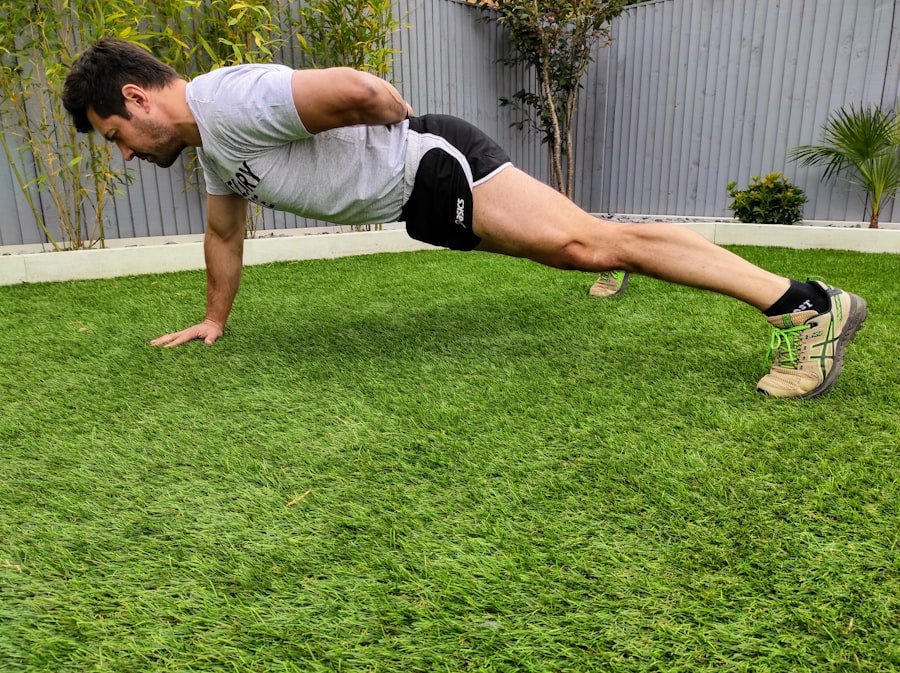
Proper form and technique are essential in calisthenics to ensure safety and effectiveness in your workouts. When performing exercises such as push-ups, squats, and planks, it’s important to pay attention to your body alignment and movement patterns. For push-ups, start in a plank position with your hands slightly wider than shoulder-width apart and lower yourself down by bending your elbows until your chest nearly touches the ground.
Keep your body in a straight line from head to heels throughout the movement to engage your core and prevent sagging or arching of the back. When performing squats, keep your feet shoulder-width apart and lower yourself down by bending your knees while keeping your chest up and back straight. Focus on pushing through your heels as you return to standing position to engage your glutes and hamstrings.
In addition to proper form, breathing plays a crucial role in calisthenics exercises. It’s important to exhale during the exertion phase of an exercise (e.g., pushing up during a push-up) and inhale during the relaxation phase (e.g., lowering down during a push-up). This helps to stabilize your core and maintain proper alignment throughout the movement.
Developing proper form and technique in calisthenics takes practice and mindfulness, but it is essential for maximizing the benefits of each exercise while minimizing the risk of injury. Proper form and technique are essential in calisthenics to ensure safety and effectiveness in your workouts. When performing exercises such as push-ups, squats, and planks, it’s important to pay attention to your body alignment and movement patterns.
For push-ups, start in a plank position with your hands slightly wider than shoulder-width apart and lower yourself down by bending your elbows until your chest nearly touches the ground. Keep your body in a straight line from head to heels throughout the movement to engage your core and prevent sagging or arching of the back. When performing squats, keep your feet shoulder-width apart and lower yourself down by bending your knees while keeping your chest up and back straight.
Focus on pushing through your heels as you return to standing position to engage your glutes and hamstrings. In addition to proper form, breathing plays a crucial role in calisthenics exercises. It’s important to exhale during the exertion phase of an exercise (e.g., pushing up during a push-up) and inhale during the relaxation phase (e.g., lowering down during a push-up).
This helps to stabilize your core and maintain proper alignment throughout the movement. Developing proper form and technique in calisthenics takes practice and mindfulness, but it is essential for maximizing the benefits of each exercise while minimizing the risk of injury.
Overcoming Plateaus: Strategies for Breaking Through Barriers
Plateaus are common in any fitness journey, including calisthenics. When progress seems to stall despite consistent effort, it can be frustrating and demotivating. However, there are strategies for breaking through plateaus in calisthenics.
One approach is to vary your workouts by incorporating different exercises or changing up the intensity or volume of your training. This can help prevent stagnation by challenging your muscles in new ways. Another strategy for overcoming plateaus is to focus on improving weak areas or addressing imbalances in your training.
For example, if you struggle with push-ups but excel at squats, dedicating more time to push-up variations or supplementary exercises can help bring balance to your training and break through plateaus. Additionally, taking adequate rest and recovery time is crucial for overcoming plateaus in calisthenics. Your muscles need time to repair and grow stronger after intense workouts, so make sure to prioritize rest days and quality sleep.
Finally, seeking guidance from a qualified trainer or coach can provide valuable insight into overcoming plateaus in calisthenics. They can assess your current training program, identify areas for improvement, and provide personalized recommendations for breaking through barriers in your fitness journey. Plateaus are common in any fitness journey, including calisthenics.
When progress seems to stall despite consistent effort, it can be frustrating and demotivating. However, there are strategies for breaking through plateaus in calisthenics. One approach is to vary your workouts by incorporating different exercises or changing up the intensity or volume of your training.
This can help prevent stagnation by challenging your muscles in new ways. Another strategy for overcoming plateaus is to focus on improving weak areas or addressing imbalances in your training. For example, if you struggle with push-ups but excel at squats, dedicating more time to push-up variations or supplementary exercises can help bring balance to your training and break through plateaus.
Additionally, taking adequate rest and recovery time is crucial for overcoming plateaus in calisthenics. Your muscles need time to repair and grow stronger after intense workouts, so make sure to prioritize rest days and quality sleep. Finally, seeking guidance from a qualified trainer or coach can provide valuable insight into overcoming plateaus in calisthenics.
They can assess your current training program, identify areas for improvement, and provide personalized recommendations for breaking through barriers in your fitness journey.
Advanced Techniques: Incorporating Variations and Progressions
As you progress in your calisthenics journey, incorporating variations and progressions into your workouts can help challenge your body in new ways and prevent stagnation. For example, once you have mastered basic push-ups, you can advance to more challenging variations such as diamond push-ups (hands close together), decline push-ups (feet elevated), or one-arm push-ups. These variations target different muscle groups and increase the difficulty of the exercise.
Similarly, progressions can be used to advance exercises such as squats or planks. For squats, you can add weight by holding dumbbells or performing pistol squats (single-leg squats). For planks, you can increase the intensity by performing plank variations such as side planks or plank with leg lifts.
Incorporating variations and progressions into your calisthenics routine not only keeps workouts interesting but also helps stimulate muscle growth and strength development by continually challenging your body in new ways. As you progress in your calisthenics journey, incorporating variations and progressions into your workouts can help challenge your body in new ways and prevent stagnation. For example, once you have mastered basic push-ups, you can advance to more challenging variations such as diamond push-ups (hands close together), decline push-ups (feet elevated), or one-arm push-ups.
These variations target different muscle groups and increase the difficulty of the exercise. Similarly, progressions can be used to advance exercises such as squats or planks. For squats, you can add weight by holding dumbbells or performing pistol squats (single-leg squats).
For planks, you can increase the intensity by performing plank variations such as side planks or plank with leg lifts. Incorporating variations and progressions into your calisthenics routine not only keeps workouts interesting but also helps stimulate muscle growth and strength development by continually challenging your body in new ways.
Fine-Tuning Nutrition: Fueling Your Body for Optimal Performance
Nutrition plays a crucial role in supporting optimal performance in calisthenics training. To fuel your body for workouts and recovery, it’s important to focus on consuming a balanced diet that includes lean proteins for muscle repair and growth, complex carbohydrates for sustained energy levels, healthy fats for hormone production and joint health, as well as vitamins and minerals for overall health. In addition to macronutrients (proteins, carbohydrates, fats), hydration is also essential for optimal performance in calisthenics.
Proper hydration supports muscle function, joint lubrication, temperature regulation, and nutrient transport throughout the body. Timing of meals is another important aspect of nutrition for calisthenics training. Consuming a balanced meal containing protein and carbohydrates within 1-2 hours before a workout can provide energy for training while consuming protein-rich foods after workouts supports muscle recovery and growth.
By fine-tuning nutrition to support optimal performance in calisthenics training through balanced meals, proper hydration, and strategic meal timing, you can maximize the benefits of your workouts while promoting overall health. Nutrition plays a crucial role in supporting optimal performance in calisthenics training. To fuel your body for workouts and recovery, it’s important to focus on consuming a balanced diet that includes lean proteins for muscle repair and growth, complex carbohydrates for sustained energy levels, healthy fats for hormone production and joint health, as well as vitamins and minerals for overall health.
In addition to macronutrients (proteins, carbohydrates, fats), hydration is also essential for optimal performance in calisthenics. Proper hydration supports muscle function, joint lubrication, temperature regulation, and nutrient transport throughout the body. Timing of meals is another important aspect of nutrition for calisthenics training.
Consuming a balanced meal containing protein and carbohydrates within 1-2 hours before a workout can provide energy for training while consuming protein-rich foods after workouts supports muscle recovery and growth. By fine-tuning nutrition to support optimal
FAQs
What is calisthenics?
Calisthenics is a form of exercise that uses body weight for resistance and minimal equipment. It includes movements such as push-ups, pull-ups, squats, and dips.
What is a muscle-up?
A muscle-up is a calisthenics exercise that involves pulling your body up from a hanging position and transitioning into a dip. It requires upper body strength and coordination.
What is a 90-day calisthenics journey?
A 90-day calisthenics journey is a structured plan to improve strength, endurance, and skill in calisthenics exercises over a period of 90 days. It typically involves progressive training and goal setting.
How can someone go from zero to a muscle-up in 90 days?
Going from zero to a muscle-up in 90 days requires a dedicated training plan that focuses on building the necessary strength and technique. This may include exercises to improve pulling and pushing strength, as well as skill work for the muscle-up transition.
What are the benefits of calisthenics training?
Calisthenics training can improve strength, flexibility, and body control. It also requires minimal equipment and can be done anywhere, making it a convenient form of exercise.